
What Does a Wedding Officiant Do? A Guide for Arizona Couples
A wedding officiant does much more than stand in front of you and pronounce you married. Your officiant helps plan and structure the ceremony, guides you through your vows and ring exchange, performs the legal marriage ceremony, completes the marriage license, and helps keep everything organized from the beginning of the ceremony through the final “I do.” In Arizona, an authorized officiant also has important legal responsibilities involving your marriage license and its return after the wedding.
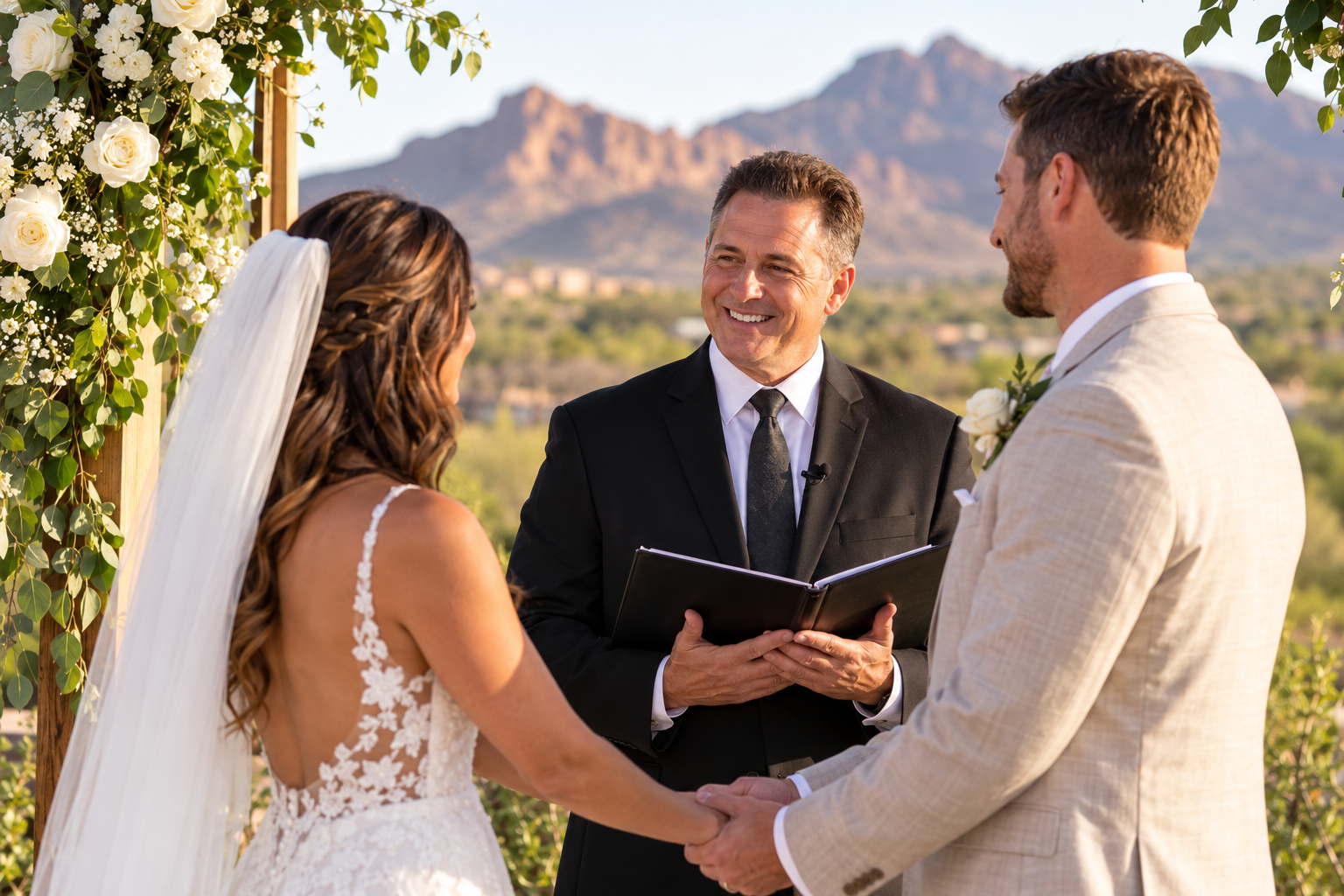
If you have never planned a wedding before, however, you may not know exactly what your officiant handles—or what you still need to handle yourselves.
Here is what Arizona couples should expect.
What Does a Wedding Officiant Do? A Guide for Arizona Couples
A wedding officiant does much more than stand in front of you and pronounce you married. Your officiant helps plan and structure the ceremony, guides you through your vows and ring exchange, performs the legal marriage ceremony, completes the marriage license, and helps keep everything organized from the beginning of the ceremony through the final “I do.” In Arizona, an authorized officiant also has important legal responsibilities involving your marriage license and its return after the wedding.
If you have never planned a wedding before, however, you may not know exactly what your officiant handles—or what you still need to handle yourselves.
Here is what Arizona couples should expect.
What Should You Discuss With Your Wedding Officiant?
One of the most important parts of planning a wedding ceremony happens before anyone walks down the aisle: the conversation between the couple and the officiant.
Your officiant should understand what kind of ceremony you actually want.
Some couples want a traditional Christian wedding with prayer and references to God. Others want something spiritual but not specifically religious. Some want a completely nonreligious ceremony.
You may also want to discuss:
- Personal vows
- Ring exchange
- Readings
- Unity Candle, Unity Cross, sand ceremony, handfasting or another unity tradition
- Children or family members participating
- Cultural or family traditions
- Special recognition of parents or other loved ones
- Wedding party and processional
- Overall ceremony length
- Whether you want the ceremony romantic, traditional, lighthearted, simple or highly personalized
This is also the time for your officiant to learn something about the two of you.
How did you meet? How long have you been together? What brought you to this point? What matters most to you about marriage?
You don’t have to tell your officiant every detail of your relationship. But sharing enough allows the ceremony to sound like it belongs to you rather than another couple whose names were replaced in a generic script.
What Does a Wedding Officiant Help Plan?
Your officiant should help you understand how the different pieces of a wedding ceremony fit together.
A typical ceremony might include:
- Processional and positioning
- Welcome and opening
- Acknowledgment of family and guests
- Ceremony message
- Declaration of Intent—the “I do” portion
- Personal vows, if included
- Ring exchange
- Unity ceremony, if included
- Pronouncement of marriage
- First kiss
- Presentation of the newly married couple
Not every wedding needs every element.
A couple having a private elopement at an Arizona park may want a short ceremony with an opening, declaration of intent, rings, pronouncement and kiss.
A couple having 100 guests at a Scottsdale resort may want a processional, wedding party, prayer, personal vows, readings, a unity ceremony and a more traditional presentation.
Neither is more legitimate than the other.
The ceremony should fit the couple.
Does a Wedding Officiant Write the Ceremony?
That depends on the officiant.
Some officiants use a standard ceremony with limited changes. Others create or personalize the ceremony based on conversations with the couple.
If having a personal ceremony matters to you, ask about this before booking.
Personalization doesn’t necessarily mean telling your entire relationship story to your guests. Sometimes a few carefully chosen details are more meaningful than a long biography.
Your officiant can also help determine where those personal details belong.
The goal should be a ceremony that sounds natural when spoken aloud, flows well and reflects both of you.
Can a Wedding Officiant Help With Personal Vows?
Yes, many professional officiants can help couples prepare personal vows.
You do not have to be a professional writer to write meaningful wedding vows.
A good place to start is by thinking about three things:
What do you love about this person?
What has your relationship taught you?
What are you promising as you enter marriage?
Your vows also don’t need to match word-for-word or be exactly the same length.
And you do not have to memorize them.
Writing them down and reading them during the ceremony is perfectly acceptable. In fact, having your vows available in writing removes the pressure of trying to remember everything during one of the most emotional moments of your wedding.
If personal vows aren’t for you, that’s okay too. Your officiant can guide you through traditional or repeat-after-me promises instead.
What Does the Wedding Officiant Do on the Wedding Day?
Before the ceremony begins, the officiant should make sure the important ceremony details are in place.
At a larger wedding, that can mean communicating with the wedding planner, venue coordinator, photographer or DJ.
At a small wedding or elopement without a planner, the officiant may provide more of the ceremony guidance directly.
That can include confirming:
- Where the couple will stand
- Who has the rings
- Where witnesses or members of the wedding party should be
- How the ceremony will begin
- When personal vows will happen
- Whether a unity ceremony is ready
- How the couple will exit after the ceremony
Once the ceremony begins, you shouldn’t be wondering what happens next.
Your officiant should guide you through it.
That is especially important because even couples who know the ceremony plan can forget everything once they are standing in front of their families and friends.
You shouldn’t have to memorize your ceremony.
What Does the Officiant Do During the Ceremony?
The officiant leads the ceremony from beginning to end.
That usually means welcoming everyone, setting the tone, delivering the ceremony message, guiding the declaration of intent, introducing personal vows when applicable, guiding the ring exchange and eventually pronouncing the couple married.
A good officiant is also paying attention to details the couple shouldn’t have to think about.
For example, before the first kiss, I step out of the center so the photographer can capture the couple’s kiss without the officiant standing directly behind them in one of the most important photographs of the day.
Small details like that can make a difference.
The couple’s job at that point should be simple:
Be present and enjoy getting married.
What Is Actually Required to Get Married in Arizona?
This is where it is important to separate wedding traditions from legal requirements.
You do not need wedding rings to be legally married.
You do not need personal vows, a wedding dress, an aisle, an arch, bridesmaids, groomsmen, music, flowers or a reception.
Those are wedding traditions and personal choices.
For an Arizona marriage, however, you need a valid marriage license and a ceremony conducted in the presence of someone authorized to solemnize marriages. Arizona law also requires at least two witnesses who are 18 years of age or older to participate in the ceremony.
Arizona law authorizes several people to solemnize marriages, including duly licensed or ordained clergy and certain judges and judicial officers.
After the ceremony, the marriage license must be signed by the couple, two witnesses and the person who solemnized the marriage.
That is why even a very small Arizona elopement still requires some planning.
Who Is Responsible for the Arizona Marriage License?
The couple is responsible for obtaining the marriage license before the wedding.
Your officiant should not arrive at the ceremony expecting to legally marry you without being presented with a valid marriage license.
After the ceremony, the officiant completes the appropriate portion of the license and the required signatures are obtained.
Under current Arizona law, the person solemnizing the marriage is responsible for returning the endorsed marriage license to the Clerk of the Superior Court for recording within 30 days after the ceremony.
Couples should ask their officiant beforehand exactly how the completed license will be handled so there is no confusion after the wedding.
What Happens After the Marriage License Is Returned?
Returning the completed marriage license and obtaining a certified copy are two different things.
The returned license must first be recorded.
A certified copy is the official copy you may later need as proof of marriage for purposes such as changing a name or updating certain legal and financial records.
In Maricopa County, couples can request certified copies through the Clerk of the Superior Court. Couples using Maricopa County’s online marriage-license program may also have the option to prepay for a certified copy as part of that process.
If you know you will need certified copies after the wedding, ask about the process when obtaining your license rather than waiting until you need one.
What Does an Officiant Do at a Small Wedding or Elopement?
At a small wedding, the officiant can become especially important because there may not be a wedding planner or venue coordinator present.
I regularly work with couples getting married in parks, backyards, private homes and other intimate settings around Arizona.
In those situations, couples often have practical questions:
Where should we stand?
Who holds the rings?
When do we say our vows?
What do our witnesses do?
When do we sign the license?
What happens after the kiss?
A simple wedding doesn’t have to feel disorganized.
In fact, one of the advantages of a small ceremony is that it can be relaxed and personal while still having enough structure to make it feel like a wedding.
What Does an Officiant Do at a Larger Wedding?
At a larger or more traditional wedding, responsibilities are usually shared among several professionals.
The venue coordinator may handle the venue.
The wedding planner may control the overall timeline and processional.
The DJ may handle ceremony music and microphones.
The photographer is watching positioning, lighting and important photo moments.
The officiant is responsible for leading the ceremony.
Those roles should work together.
Before the ceremony, I like to connect with the professionals involved so everyone understands the flow and we aren’t trying to solve basic coordination issues while the couple is preparing to walk down the aisle.
If you are planning a larger wedding, ask your officiant how they work with your planner, coordinator, DJ and photographer.
Does Your Wedding Officiant Need to Attend the Rehearsal?
Not every wedding requires the officiant to attend a rehearsal.
For a small ceremony with only a few participants, a detailed conversation beforehand may be enough.
For a larger wedding with a wedding party, processional, children, readings, unity ceremony or several moving parts, a rehearsal can be much more valuable.
The purpose isn’t to rehearse every word of the ceremony.
It is primarily to make sure everyone understands where to go, when to move and what happens next.
You generally don’t want to rehearse the emotional parts so many times that the actual ceremony begins to feel like another practice run.
What Should Your Officiant NOT Be Responsible For?
An officiant can be very helpful, but an officiant is not automatically your wedding planner.
Unless you’ve specifically arranged otherwise, you shouldn’t assume the officiant is responsible for your reception timeline, seating arrangements, catering, decorations, venue setup or managing every wedding vendor.
For smaller weddings without a planner, an experienced officiant may naturally provide additional guidance around the ceremony.
For larger weddings, clearly defined roles are better for everyone.
Knowing who is responsible for what prevents confusion.
How Do You Choose the Right Wedding Officiant?
Don’t choose an officiant based only on whether that person is available on your wedding date.
Have a conversation.
You are going to stand beside this person during one of the most important moments of your wedding day. You should feel comfortable with the way they communicate and confident that they understand what you want.
Consider asking:
- Are you legally authorized to perform marriages in Arizona?
- How do you personalize ceremonies?
- Can we write our own vows?
- Can you help us with our vows?
- Can the ceremony be Christian, spiritual or completely nonreligious?
- Can we include cultural or family traditions?
- How do you handle the marriage license after the ceremony?
- Will you work with our planner and photographer?
- Do you attend rehearsals when needed?
- When will we speak again before the wedding?
- What happens if our plans or location change?
There isn’t one perfect ceremony style for every couple.
There also isn’t one perfect officiant for every couple.
The goal is to find someone whose approach fits the wedding you want.
Your Officiant Should Help You Enjoy the Ceremony
Couples spend months making decisions about venues, clothing, flowers, food, photography and music.
But the ceremony is the moment when you actually get married.
By the time you are standing together on your wedding day, you shouldn’t be thinking about where to stand, when to speak, who has the rings or what happens next.
That is where a prepared wedding officiant makes a difference.
The planning has already happened.
The details have already been discussed.
Now you can look at the person you are marrying, listen to the words being spoken, say your vows, exchange your rings and enjoy the moment.
If you’re planning a wedding in Scottsdale, Phoenix, Mesa, Chandler, Gilbert or elsewhere in Arizona and have questions about your ceremony, marriage license or what type of ceremony would work best for you, Arizona Wedding Officiant can help you understand the process and plan the next steps.
✨ Your Love Story, Your Ceremony, Your Way.
Frequently Asked Questions About Topics to Discuss Before Getting Married
What does a wedding officiant do?
A wedding officiant leads the wedding ceremony, guides the couple through elements such as the declaration of intent, vows and ring exchange, pronounces the couple married, and completes the officiant’s legal responsibilities associated with the marriage license. Many professional officiants also help couples plan and personalize the ceremony beforehand.
Does a wedding officiant write your vows?
Usually not unless that service is specifically offered. Couples can write personal vows themselves, use traditional vows, or use repeat-after-me wording. A professional officiant may also provide guidance to help couples write personal vows.
Do you need rings to get married in Arizona?
No. Wedding rings are traditional but are not required for a legal Arizona marriage.
Do you need witnesses to get married in Arizona?
Yes. Arizona law requires at least two witnesses who are 18 years of age or older to participate in the marriage ceremony.
Who signs an Arizona marriage license?
Arizona law requires the marriage license to be signed by both people getting married, two witnesses and the person who solemnized the marriage.
Who returns the marriage license after an Arizona wedding?
Under Arizona law, the person who solemnizes the marriage is responsible for returning the endorsed marriage license to the Clerk of the Superior Court for recording.
How long does an Arizona officiant have to return the marriage license?
Arizona law requires the officiant to return the endorsed marriage license to the Clerk of the Superior Court within 30 days after the marriage is solemnized.
Can an Arizona wedding ceremony be nonreligious?
Yes. A wedding does not have to contain a prayer or religious language simply because an ordained minister is performing it. Couples can choose a religious, spiritual, nonreligious or personalized ceremony consistent with their preferences.
Can an officiant perform a small wedding or elopement?
Yes. An officiant can perform anything from a simple ceremony with the couple and two adult witnesses to a large traditional wedding with a full wedding party and hundreds of guests.
Do we have to memorize our wedding vows?
No. You can read personal vows, repeat short vows after your officiant or use another format that makes you comfortable. Your wedding ceremony should not feel like a memory test.


